Kerf & Code · Six Axes
SIX AXES
Your table already tells the story. This writes it down.
Six Axes sits in your session, transcribes it, and turns it into the work you would do afterwards if you ever had the time: the recap, the campaign wiki, and a record of what actually happened at the table. Across your system, not just one.
Free while in pilot. No card, no commitment, and you can take all your data out again.
How it works
What game night actually looks like
Three steps, and you keep running the table exactly the way you do now.
Record the session
Play the way you already do. The Discord bot records your voice channel with each player on their own track; in person, it reads the dice and the numbers your table says out loud; and on D&D Beyond, the Chrome extension catches every roll. Everyone opts in first, and anyone can stop it at any time.
It does the after-work you never get to
Once you wrap, Six Axes transcribes the night, sorts out who did what, and pulls out both halves of the game: the mechanics (attacks, saves, damage, hit points) and the story (the NPCs, places, factions, and threads that came up). It drafts the recap and files the rest, in the background, while you pack up.
Review, and get your night back
You skim what it found and approve what goes in, nothing lands without your say. Out comes a player-ready recap, your campaign wiki brought up to date, and a fresh read on how each player is engaging across the six axes, so you know who to aim next session at.
See what comes out
What lands the morning after
The recap your players actually read, and the read on your table only Six Axes can give. An example from a demo campaign.
Session 7 — The Sunken Vault
The party finally reached the flooded undervault beneath Emberhold, guided by the map Gnarl the innkeeper sold them two sessions back. Mirella picked the rusted lock while Tharn braced the collapsing archway, buying just enough time for everyone to slip through before it came down.
Below, they disturbed a shrine to the Ashen Hand and woke its guardian, a drowned knight that nearly dropped Bram before Kessa's thunderous rebuke turned the fight. They left with the Tidewrought Signet and a warning carved in old Draconic that no one could yet read.
Open threads: the Ashen Hand knows the party was here, Bram is down to his last two healing draughts, and Gnarl still hasn't said how he knew the vault existed.
Things you half-notice on the night and forget by the next one:
Your data, handled straight
You're recording your table. We take that seriously.
The reassurance a GM actually wants, in plain terms. All of it is spelled out in full on the privacy page.
No one is recorded until they have agreed, and anyone at the table can stop it at any point in the session.
Recordings delete themselves 60 days after the session. Only the transcript and the moments you choose to keep stay.
The services that transcribe and analyze your sessions do not train their models on your table's data.
Your session data is encrypted in transit between your table and us.
Export everything as a single file whenever you want. Delete your account and your personal data and recordings go with it.
Every outside service that touches your data is named in the privacy policy, with exactly what it does.
Mechanical capture
It knows what you rolled
This is the part other tools cannot do.
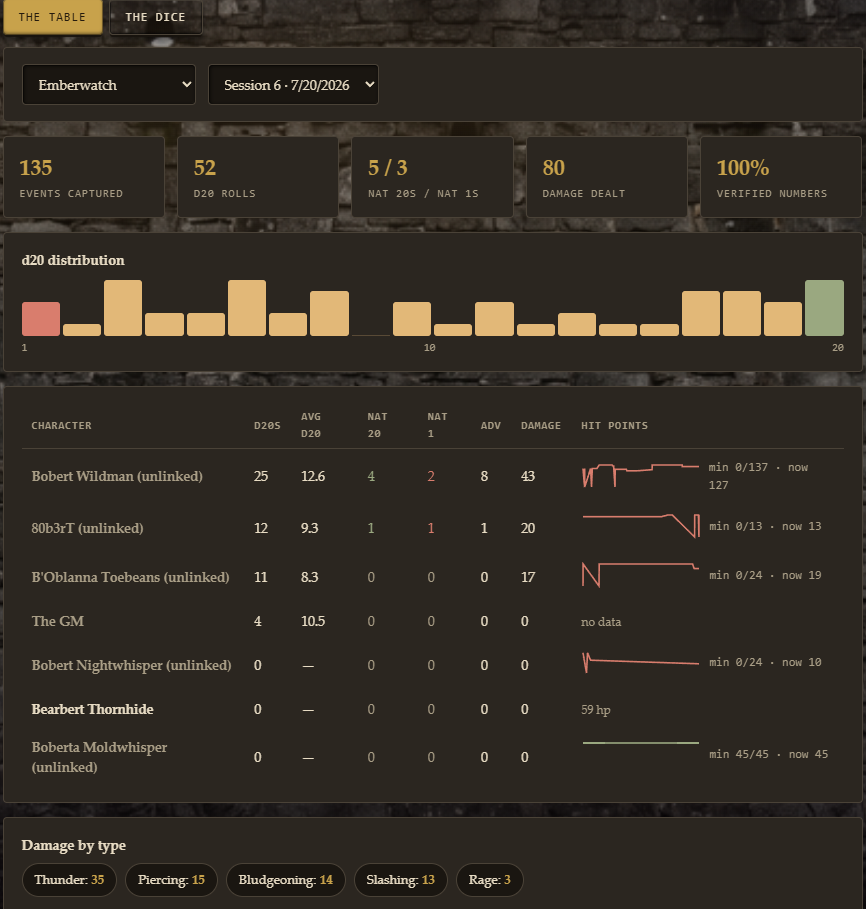
Most session tools listen and summarise. Six Axes also captures the mechanics: attacks, saves, damage, hit points, who rolled what and when. On a supported virtual tabletop those numbers arrive automatically; playing in person with real dice, it reads the numbers your table says out loud.
Which lets it do arithmetic nobody else can. It knows the fight it called Moderate left the party at a third of their hit points, and it can tell you that your Moderate encounters land like Hard ones, at your table specifically, across a whole campaign.
The living wiki
A campaign wiki that writes itself
Because nobody has ever kept one up to date by hand.
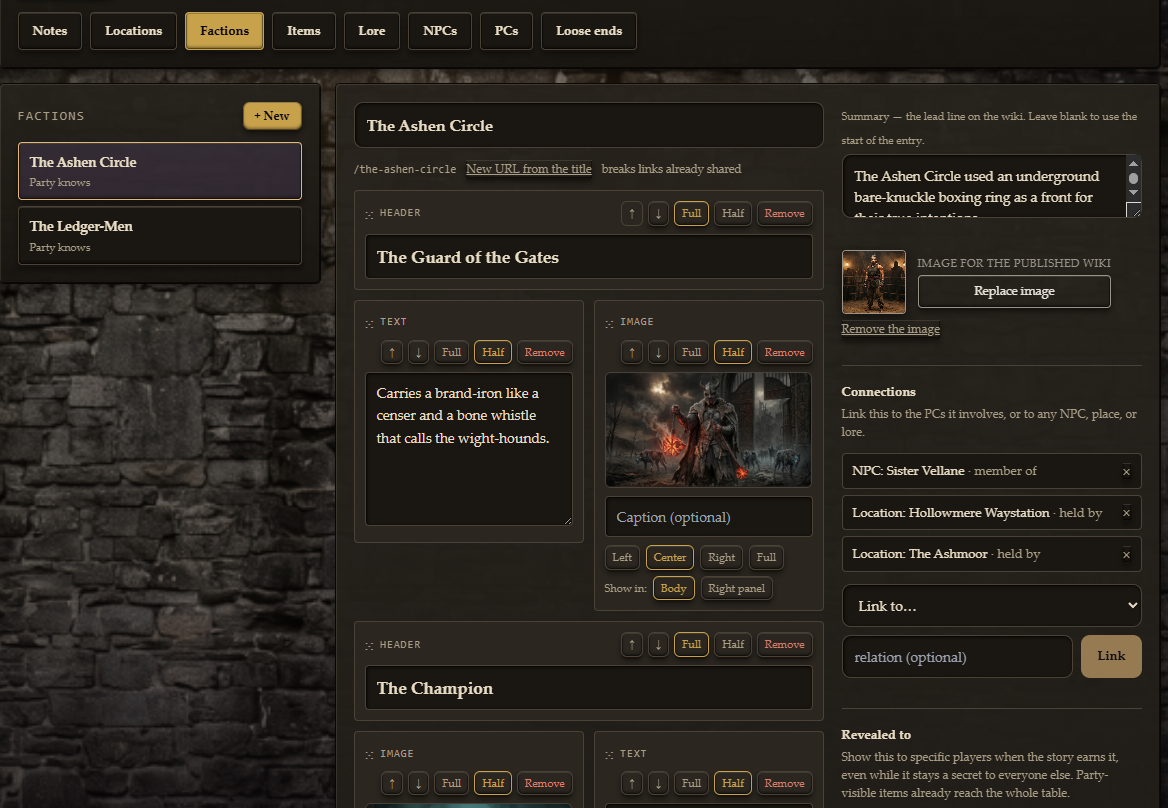
Every NPC the party meets, every place they go, every faction and thread and piece of loot gets captured from what was narrated and filed where you can find it. You approve what goes in. By session five you have the campaign bible you were never going to write.
When it is worth sharing, publish it as a page anyone can read, no account needed. You choose exactly what appears, so the setting and the cast can go public while the things your players have not found yet stay yours.
Player insight
It tells you how your table is doing
In plain language, not charts.
Which threads you have left hanging for four sessions. Who has not had a scene in a while. That one character is quietly holding two thirds of the party's loot. The things you half-notice on the night and have forgotten by the next one.
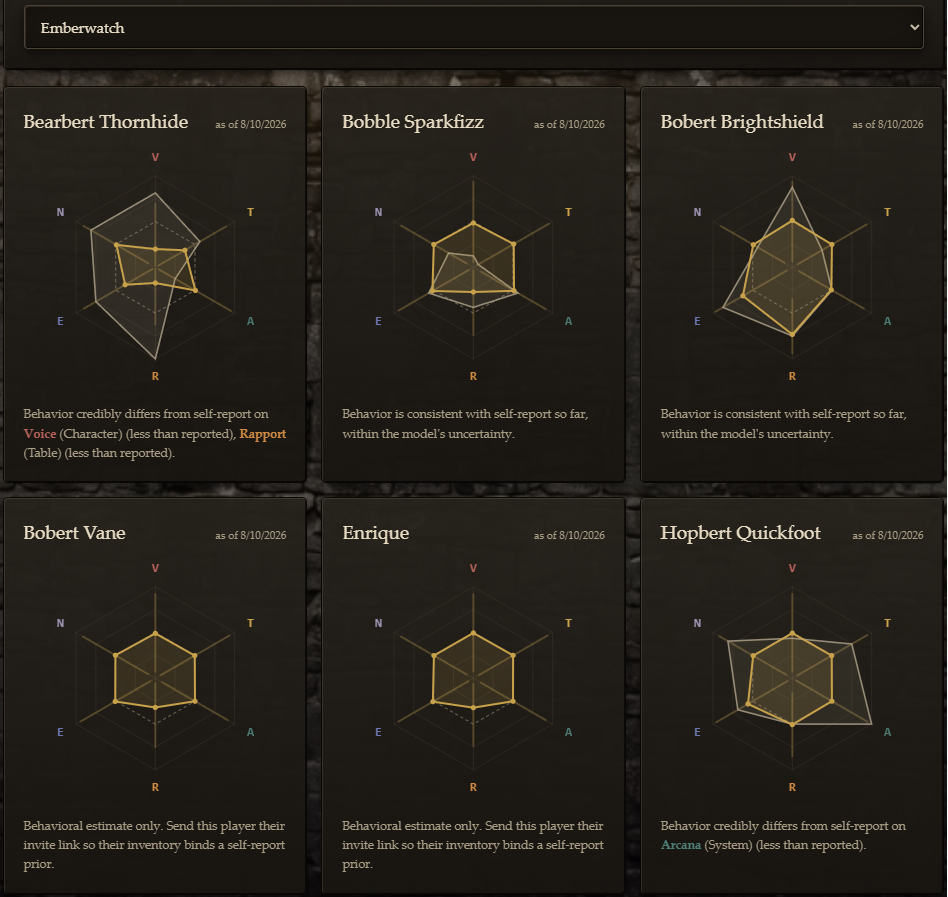
It also builds a read of how each player engages, across six axes: tactics, arcana, voice, exploration, rapport, and nerve. It is not a score and no axis is the good one. It exists so you can notice you have not given someone a scene that plays to what they actually enjoy.
- Tactics · Tactical play
- Arcana · Optimization & mastery
- Voice · Narrative & immersion
- Exploration · Exploration & discovery
- Rapport · Social & cohesion
- Nerve · Engagement intensity
Maps & world
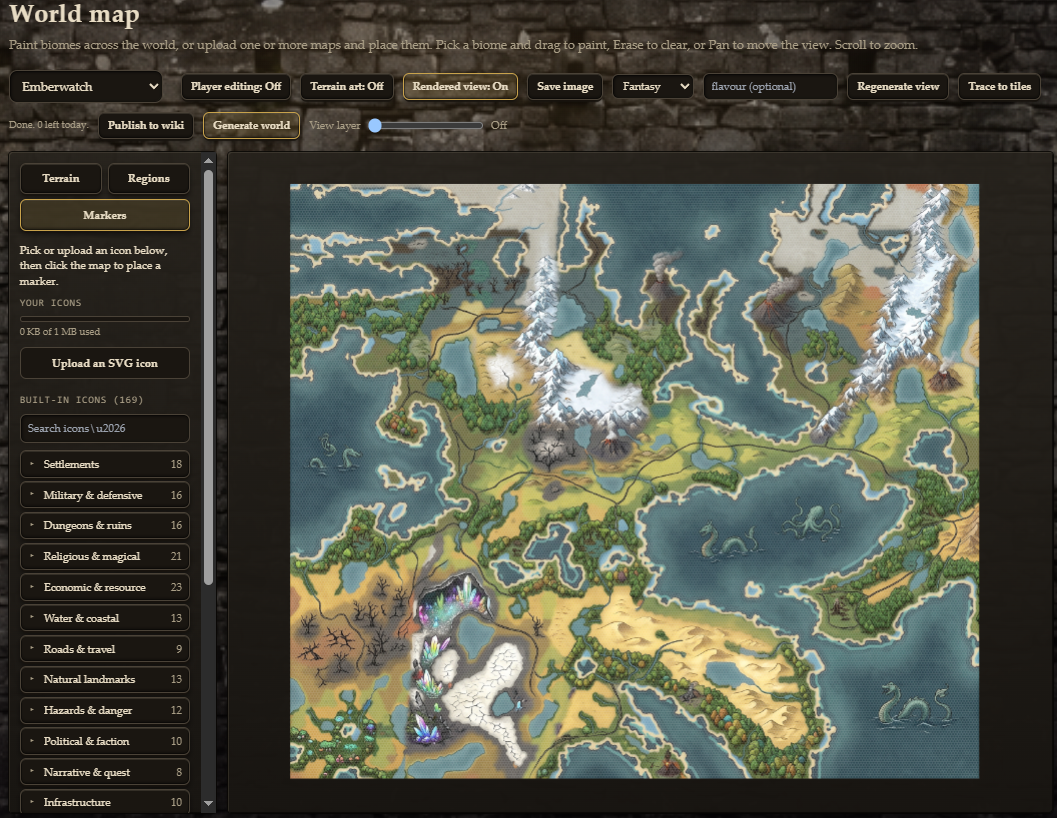
Build the world, four scales deep
World, city, dungeon, and building, all yours.
Generate a hex world from a seed, or paint biomes by hand up to 250 by 250, then have it rendered as a finished map. Drop pins, link each to a place or an NPC, and trace where a session actually went. City, dungeon, and building maps use the same brush-and-render loop.
A slice of it, the generator, is one of the free tools below. Inside a campaign it ties to your codex, your sessions, and what your players are allowed to see.
Your system
Works with your system
Honestly, because the depth varies by system.
Character builder, monsters or NPCs, encounter maths, system-correct dice.
D&D 5e (2014 and 2024) · Pathfinder 2e · Draw Steel · Daggerheart
The right roller and the system's look, character and monster builders still to come.
Call of Cthulhu · Lancer · a generic d10 pool
On the roadmap, waiting on the publisher's permission before we can ship them.
Cyberpunk RED · Vampire: The Masquerade
The record, recap, wiki and player insight work the same on every system. System names are referenced for compatibility only; see the Terms for the Lancer, Daggerheart and Draw Steel attributions.
Free tools
Small, sharp tools, no login
Some of what Six Axes does is useful on its own.
Integrations
It meets your table where it plays
The bot records your voice channel with each player on their own track, then files the recap, for the tables that already live in Discord.
Rolls from D&D Beyond and Roll20 come in through the browser, so mechanical capture reaches your online table without a separate setup on the night.
A Foundry module pipes every roll straight in. Set it up →
The Discord bot and the browser capture are set up when you join the pilot.
The pilot
Looking for pilot tables
This is early. It works, it is in use at real tables, and it is not finished. What it needs most is more campaigns and honest feedback, including the unflattering kind. The pilot is invitation-based right now, so tell us about your table and we will get you in.